
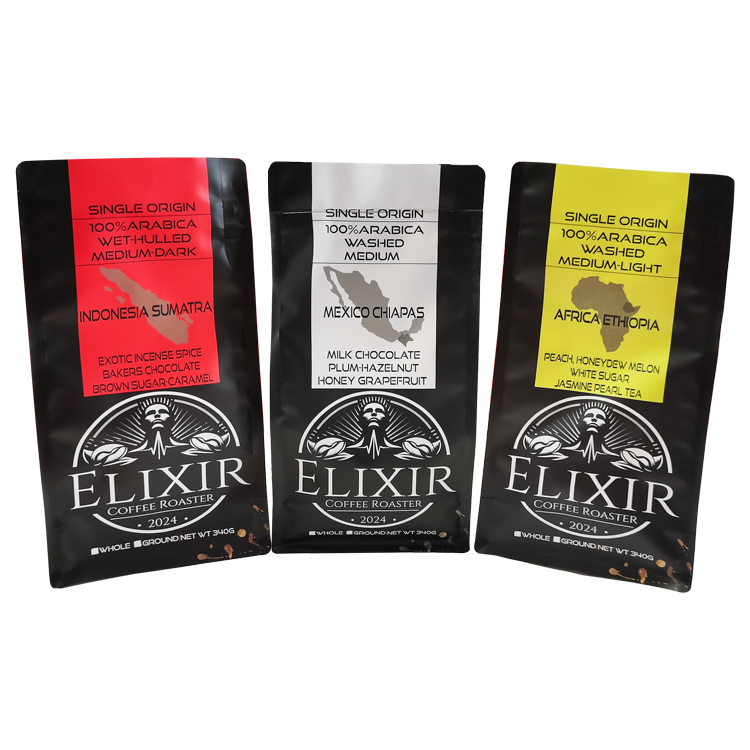
An order total alone can hide the important differences. Several bags with identical artwork create one printing question; the same total divided among coffees with different names, colors and information creates another. A seasonal coffee whose artwork will change again also deserves a different review from a core blend with a settled design.
We make digitally printed and gravure printed coffee bags. The examples below show those processes on real formats and material structures. They help you compare what can be made; the choice for your own range comes from your designs, specifications and quotation.
Start with quantity per design, not just the order total
Build a SKU list
For printing, identify every distinct artwork version you want to order. Your sales system may call each coffee a SKU, but the packaging brief needs to show the actual printed differences. Two sales items can share one bag if you add their distinguishing information during packing. Conversely, one coffee can need several printed files if you sell different weights or whole-bean and ground versions.
List the quantity next to each design. If you only send a combined order total, we cannot see which printed versions account for that volume. Include the designs whose quantities are still estimates and say which coffees are temporary or expected to be reordered.
| Information | What to put in the list | Why it affects the comparison |
|---|---|---|
| Design identity | Coffee name and artwork revision | Connects each quantity to the correct file |
| Bags per design | Your planned quantity for that version | Defines the individual printed runs to compare |
| Physical specification | Format, dimensions, material, thickness and features | Identifies which versions use the same bag |
| Artwork differences | Text, colors, graphics, codes and printed areas | Shows what changes between designs |
| Future changes | Stable, seasonal or likely to be revised | Helps compare preparation across later orders |
| Timing | Required delivery date and expected reorder pattern | Connects print planning to the whole project |
This list does not need a confident long-term sales forecast. Give the order you are considering now and identify uncertainties plainly. We can discuss a first order separately from a possible repeat, using the same specification where it makes sense.
Separate shared specifications from shared artwork
Several coffees can share a bag format while using different artwork. That creates useful consistency, but it does not make all production details identical. Check the dimensions, material structure, finish, valve and closure before describing the range as one common bag.
Similarly, a shared logo does not mean the complete designs are the same. A changing coffee name or back-panel paragraph is still printed content. For gravure, those differences need review against the relevant color separations and cylinder preparation. For digital printing, each file still needs the right layout and approval.
Group the range by physical specification first, then show the artwork variations within each group. If your retail bag and wholesale bag have different sizes or materials, identify them separately. We can then discuss the proposed arrangement without treating every design as part of one interchangeable print run.
What changes between digital and gravure printing
Digital artwork and design changes
Digital printing uses artwork files without engraved gravure cylinders. That makes it useful to compare when your coffees have different printed designs or when information is likely to change. A revised origin description can be brought into a new approved file without treating that revision as a gravure cylinder change.
The file still belongs to a specific bag. A new dimension, different material or changed opening arrangement may need another layout review. Digital printing also leaves the downstream work of lamination, conversion and feature application in place; selecting digital does not turn a printed film into a finished coffee bag by itself.
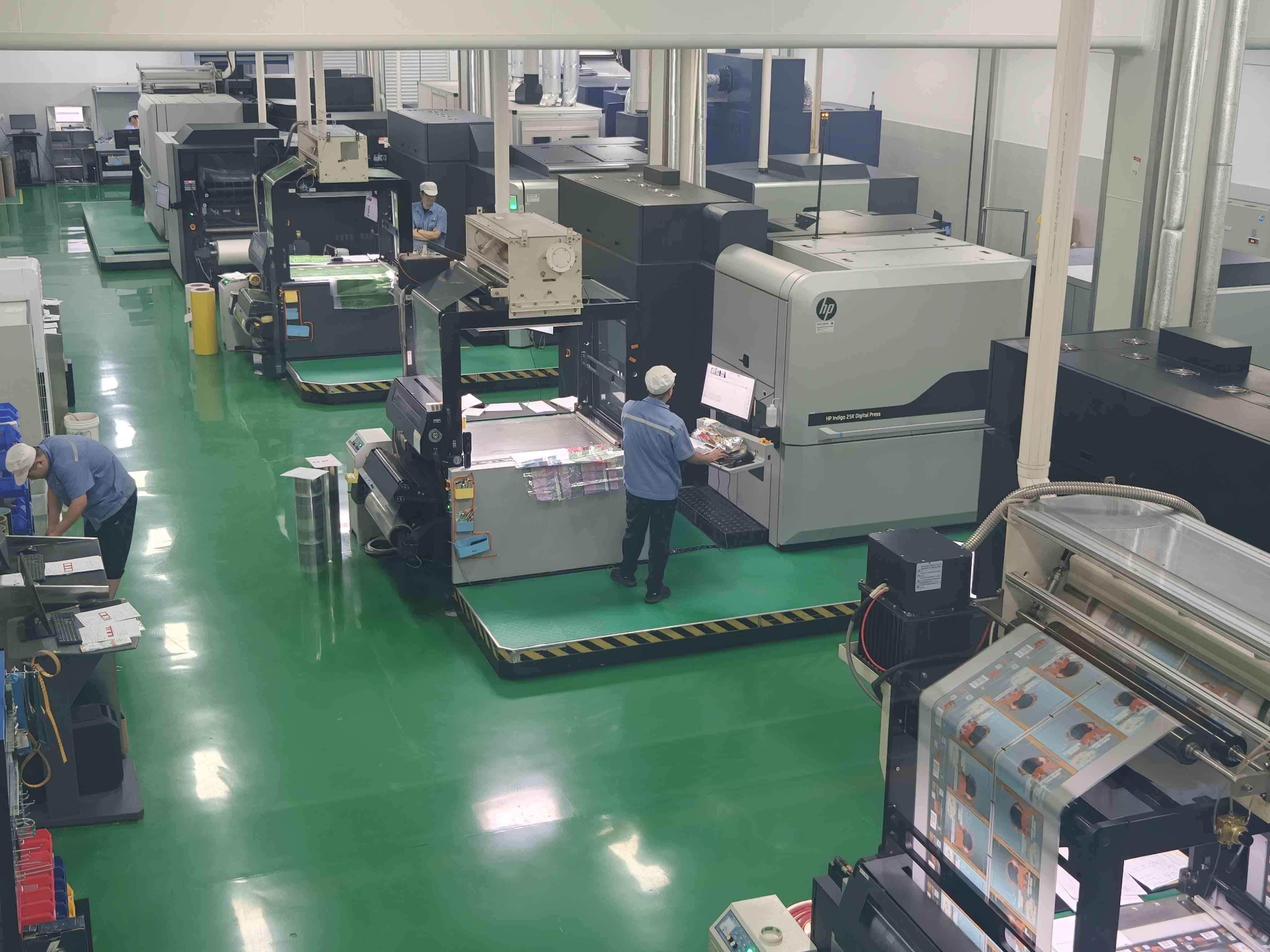
HP's flexible-packaging information describes digital production for on-demand and short-run work. Use that general capability as context, then ask us to compare the particular material, artwork and quantity you want. We quote the finished bag around those project details.
Our digital coffee bag printing page explains the available bag formats and the information to send. For a range, the quantity of each design and its expected changes are especially useful inputs.
Gravure cylinders and repeat preparation
Gravure prints from engraved cylinders. Recessed cells carry ink, and a doctor blade removes excess ink from the cylinder surface before transfer. The Global Rotogravure Association explains this mechanism in its process overview. For your order, the practical consequence is that approved artwork and color separations determine the cylinder preparation to discuss.
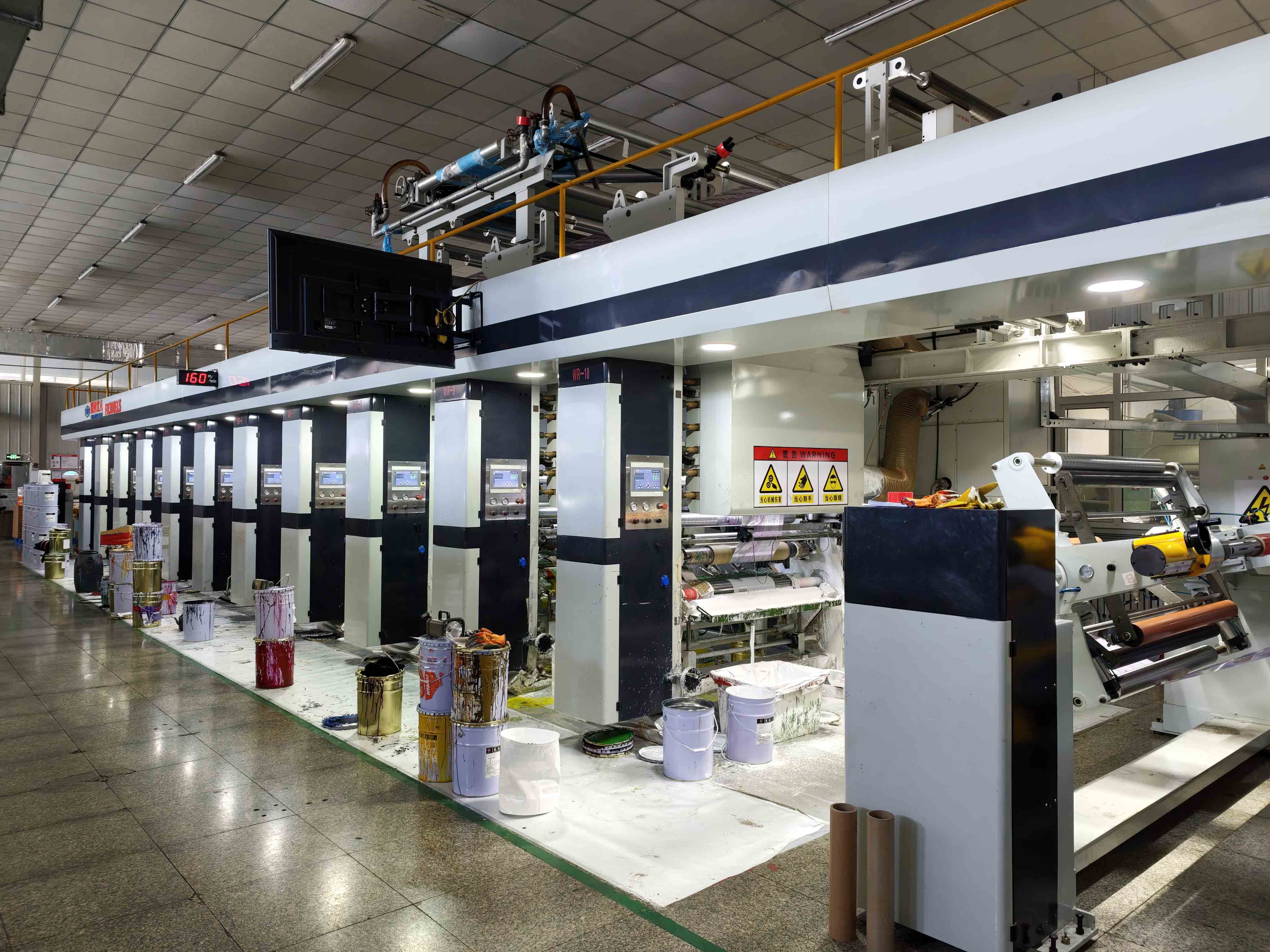
Stable artwork gives you a useful basis for discussing future use of the same preparation. Ask which cylinders would be required, which items are charged and what is possible for later orders. A repeat is still reviewed against the current specification, artwork version, cylinder availability and condition.
Do not assume a small wording change has a small production effect. A revised sentence, changed net weight or new barcode may affect a printed separation. Send the actual file change so we can explain its preparation requirements. The gravure printing page describes the information needed for that review.
| Decision | Digital printing | Gravure printing |
|---|---|---|
| Artwork preparation | Approved digital files; no engraved gravure cylinders | Approved artwork and color separations reviewed for cylinders |
| Several designs | Compare file variants and quantity per design | Compare the differences and preparation required for each design |
| Revised printed content | Review and approve the new file | Review the file and any affected cylinder preparation |
| Stable repeat order | Confirm the saved file and complete bag specification | Confirm the saved file, specification and suitable available cylinders |
| Final appearance | Review on the actual material and finish | Review on the actual material and finish |
| Cost decision | Quote the complete order, including applicable preparation | Quote bags and cylinder preparation, including repeat terms |
Compare real printed coffee bag configurations
A digitally printed 12 oz flat bottom range
Our digitally printed mono-PP flat bottom bags for 12 oz measure 12.5 × 24 + 7.5 cm. We used MOPP / VMOPP / CPP at 140 µm, with a zipper and degassing valve. The coffee fill is 12 oz, approximately 340 g.
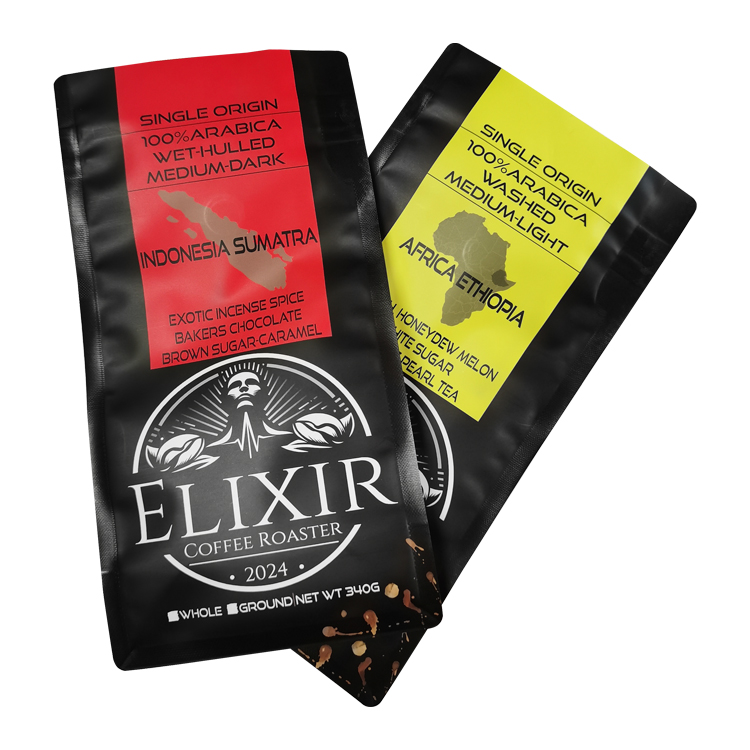
For your own range, this is a concrete reference for shared packaging and changing printed information. You can ask us to retain a common logo position and panel structure while adapting the coffee-specific wording. Give the quantity of every version when requesting a printing comparison.
The material structure is part of this example, not a condition imposed on all digitally printed bags. Your proposed laminate, finish and accessories should be specified independently and then reviewed with the print route.
Digitally printed stand-up and side gusset bags
We made our illustrated stand-up pouches for 8 oz beans in 15 × 23 + 5 cm using MOPP / VMPET / PE, 140 µm film, digital printing and a degassing valve. The two front designs use blue and pink backgrounds with illustrated cups. Eight ounces is approximately 227 g; it remains a different coffee quantity from a 250 g pack.
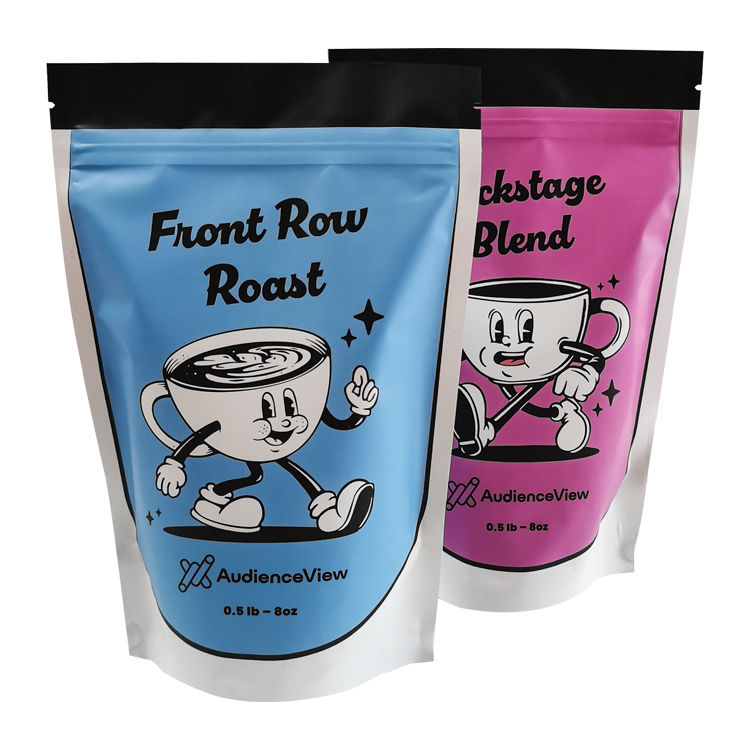
This shows that a coordinated range does not need to repeat the same illustration unchanged. Decide which visual elements should hold the range together and which should identify the individual coffees. Then review both fronts and their information panels as separate approved versions.
Our digitally printed side gusset bags for 500 g beans use 10 × 34 + 6 cm dimensions and MATOPP / VMPET / PE at 140 µm. The specification includes a degassing valve and matte finish. Its green and white artwork continues into an orange side area.
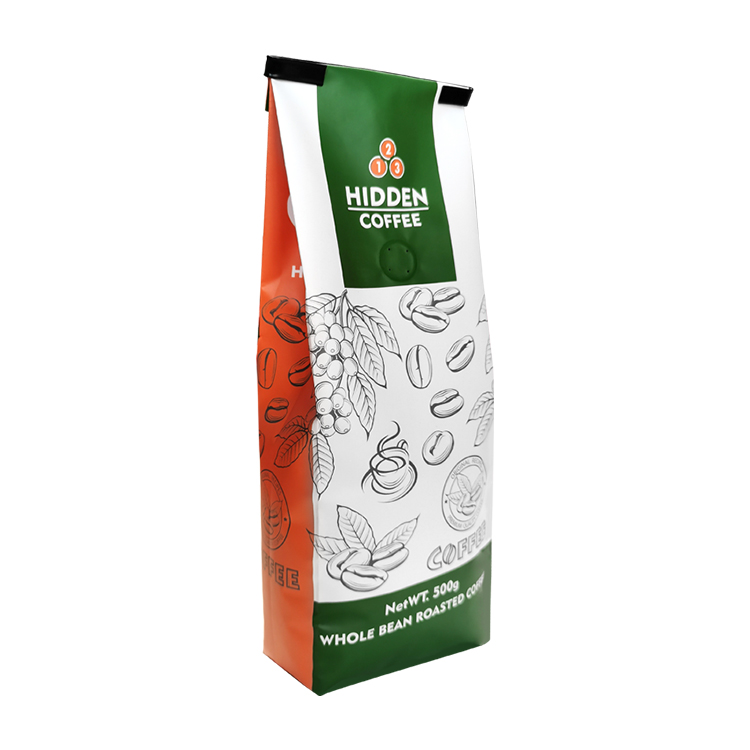
Digital printing therefore needs to be considered with the selected bag shape. A stand-up front, separate flat bottom panels and a folding side gusset place different demands on the artwork, even when the same logo appears across the range.
A gravure printed 250 g stand-up pouch
We made our matte stand-up pouch for 250 g beans in 15 × 23 + 5 cm using MATOPP / VMPET / PE, gravure printing and a degassing valve. The front has gold-colored compass artwork on a dark blue background.
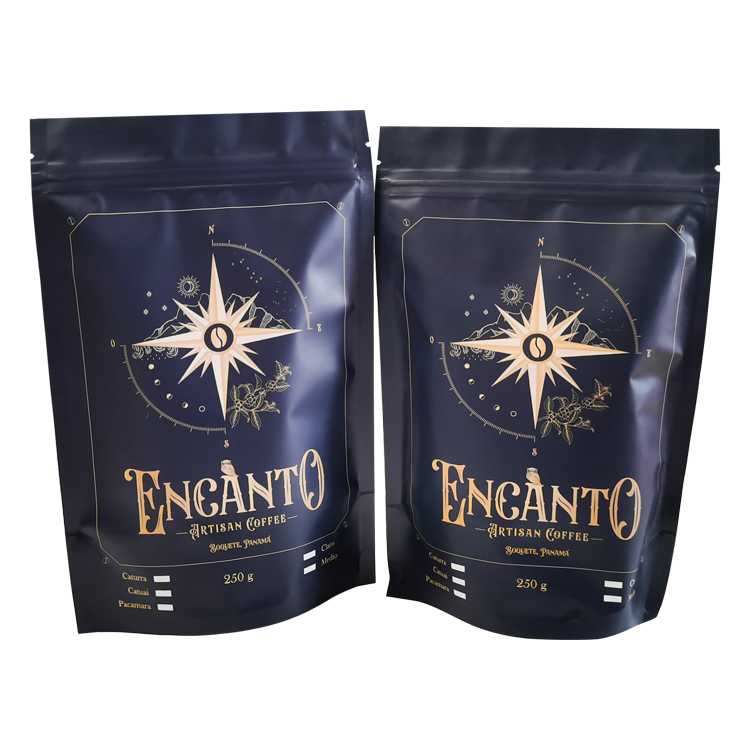
Use this as a real print-and-format reference when describing your desired appearance. Gold-colored artwork is a visual description; if you want foil stamping, metallic ink or an effect involving the underlying film, name that requirement separately. Different ways of producing a similar-looking color can change the specification and quotation.
These configurations show the formats and materials we can combine with printing. To choose for your brand, compare digital and gravure on one agreed bag specification and the same set of designs.
Match the process to your order pattern
New and changing coffees
Start the digital comparison when you have several coffees whose information is still evolving. The important advantage to examine is how approved files and quantities can be arranged without engraved gravure cylinders. Your first order may need flexibility for changing names, graphics or information on the next order.
Make those expected changes explicit. A coffee that returns every year with the same brand design may still need a new origin paragraph or harvest reference. A core layout can remain recognizable while individual printed elements change. Discuss that pattern before investing in preparation intended for stable artwork.
Digital printing is not automatically the lowest-cost route for every project. It is a candidate to quote alongside the finished material, bag construction and quantity of each version. If a particular appearance is essential, review the available print and finish combination rather than making the decision from order size alone.
Stable core designs
For settled designs that you expect to reorder, compare gravure with digital over the orders you actually anticipate. A first quote may include preparation that is treated differently on a later order. Ask for those terms instead of assuming that the first quoted bag price predicts every future purchase.
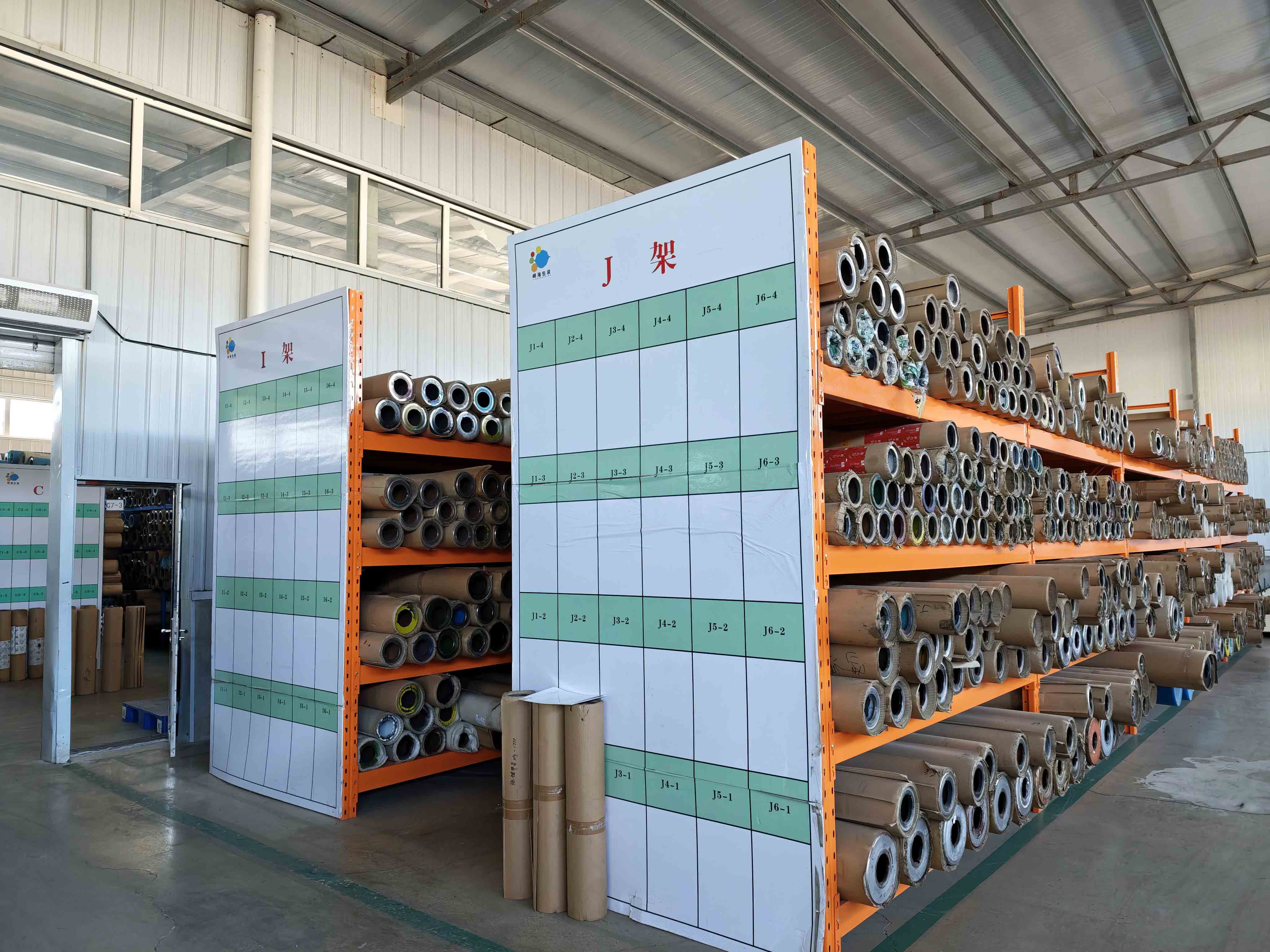
Confirm availability and retention arrangements for your own cylinders, along with any conditions relevant to reuse. Share the approved bag dimensions and files so we can review which preparation is suitable for the proposed reorder.
Stability includes the information panel, not just the logo. A settled front with a changing back is still a changing design. Check planned updates to contact information, coffee wording, weight declarations and codes before treating the whole bag as a long-term repeat.
A range with both
A brand can have stable blends and temporary coffees at the same time. Ask for a comparison that shows those groups separately. One route might suit the core designs while another deserves consideration for artwork that changes frequently.
If you consider different print routes within one range, review their physical appearance together. Decide which elements need to look consistent across the finished bags, such as a black background, white brand mark or a key accent. Agree suitable references for the materials and finishes being compared.
Also review the effect on ordering and inventory. Separate production arrangements may have separate quantities, preparation and schedules. The aim is a workable range for your coffee business, with clear specifications for each group; confirm the proposed combination in the quotation.
Compare first orders and reorders on the same specification
Ask for itemized preparation costs
Put the same dimensions, laminate, film thickness, finish, valve and closure in both requests. Include the artwork versions and quantities. Otherwise, a lower quotation may reflect a different bag rather than a difference in printing economics.
Ask which printing preparation items apply and whether they are included in the bag price or listed separately. For gravure, ask for the cylinder requirements and charges. For digital, ask about applicable print preparation and production costs without assuming that the absence of gravure cylinders makes all preparation free.
Our packaging design is free, with unlimited revisions. After design approval, we provide the layered production files free of charge. Physical printing cylinders, custom samples, production and delivery are separate project items. The quotation should make their treatment clear.
Compare the first-order total for the quantity you plan to receive. Then ask for a repeat comparison using the current design and specification, showing which preparation items would change. Keep shipping and destination assumptions the same in both comparisons.
Review the effect of artwork changes
Before a reorder, send a change list alongside the previous approved version. Separate unchanged designs from revised ones, and identify the printed elements that changed. Ask how the revision affects file preparation, cylinders where applicable, samples and timing.
For gravure, shared design elements may allow some common preparation, but a shared layout does not guarantee complete cylinder sharing. We review the actual color separations and differences. For digital, each new file still needs to match the agreed bag and be approved for that version.
If you change the bag dimensions, request a fresh layout review even when the graphics remain familiar. A wider front, different gusset or relocated valve can change the relationship between the artwork and the formed bag. Keep the approved physical specification with the artwork so a reprint does not rely on memory.
Check color and finish on the actual material
White, kraft and metallized surfaces
The material and print preparation influence what the same artwork looks like. Tell us whether a color should be opaque, whether the material should remain visible and whether part of a metallized surface is meant to contribute to the design. A white layer can be a deliberate part of that preparation.
Keep the material names precise. VMPET is metallized PET; it is not a separate AL aluminum foil layer. A gold-colored image does not specify foil stamping, and a matte appearance does not identify the whole laminate. Use a written structure and finish description alongside the reference photograph.
Choose a physical reference when an important brand color needs close review. A previous printed bag can be helpful if you identify which color to compare and how the proposed surface differs. Do not rely on a bright screen as the only appearance reference for a bag printed on a different substrate.
Codes, small text and folded panels
Review fine text and printed codes at their intended size and location. A design can look clear when magnified on a screen yet become difficult to read after the bag is formed. Folds, seal areas, valve positions and opening features affect that reading experience.
Provide the approved barcode or QR content rather than a decorative placeholder. Agree the suitable review on the finished sample, including scanning where needed for its intended use. Keep an area for variable date or lot coding separate from the elements that will be permanently printed.
Use the Coffee Bag Artwork Checklist for the detailed production handoff. Every design deserves that review, whichever process you choose. Print preparation can support a consistent range only when the right files are attached to the right quantities.
Keep the printing decision connected to the finished bag
Printing is one part of the specification. The bag still needs to hold your intended coffee, work with your filling and sealing method, and offer the chosen valve and opening arrangement. A printing change alone does not establish barrier performance, coffee shelf life or an environmental disposal claim.
Confirm coffee net weight separately from film thickness. The digitally printed 12 oz flat bottom example uses 140 µm film, while its coffee fill is approximately 340 g. Those figures answer different questions. Similarly, the 8 oz and 250 g stand-up examples share a dimension notation but remain different project specifications.
If changing the material or format is part of the comparison, identify that as a separate option. For example, quote one film-based bag through both processes first, then review a kraft construction as another specification. This makes it easier to understand whether a price or appearance difference comes from printing or the bag itself.
Samples should be chosen for the unresolved decisions. Similar-material samples are free. Custom sample fees are refunded when an order is placed, and sample shipping is quoted according to destination. Explain whether you need to examine material feel, artwork appearance, filled shape or a specific feature arrangement.
The sample-testing guide helps you record the physical review. Keep that record with the approved artwork and quotation so the chosen process is part of one complete bag decision.
Prepare a useful printing comparison request
Send a design list with the information below. If the bag is undecided, ask us to recommend a starting specification before preparing the final comparison.
- Coffee type and net weight, with the planned bags for each printed design.
- Bag format and the exact dimension notation, or a current bag to use as a reference.
- Complete material structure, film thickness where specified, finish and features.
- The artwork differences, important colors and any white, clear or decorative areas.
- Which designs are stable and which may change on later orders.
- The existing approved files or a request for free design help.
- Delivery country, target date and the preparation items you want explained.
Ask for the first-order and repeat-order costs to be identified separately. Also ask what happens if a name, information panel or bag size changes. This creates a comparison you can use, rather than a general statement that one printing method is cheaper.
Production is 7–12 days and shipping is 7–10 days as separate stages. Artwork development, cylinder preparation where required and sample arrangements also need to be considered for your project. Give us the launch or replenishment date so we can discuss the whole sequence.
Frequently asked questions
Can I use one printed bag and add the coffee name later?
You can discuss a shared printed design with an area for a label or other marking. Specify how you will identify each coffee, what surface the marking will use and which information remains permanently printed. Review the proposed method on a suitable bag sample before fixing the layout.
Can I change where a printed QR code leads without reprinting the bag?
That depends on how you set up the destination. If the printed code points to a web address you control, you may be able to update the page at that address while keeping the printed symbol. Confirm the planned destination and test the final code; a changed encoded address requires a new printed symbol.
Should I approve the design on an empty or filled bag?
Both views answer useful questions. The flat layout helps check wording and panel placement; a formed, filled sample helps show folds, proportions and feature access. Agree the sample scope and examine the parts of the design that depend on the filled presentation.
Further Reading
Discuss printing for your coffee range
Send us the quantity for each design, the bag specification and the changes you expect on future orders. We can compare digital and gravure printing for the project and help develop the artwork through free design, unlimited revisions and free layered production files after approval. Discuss your coffee range.